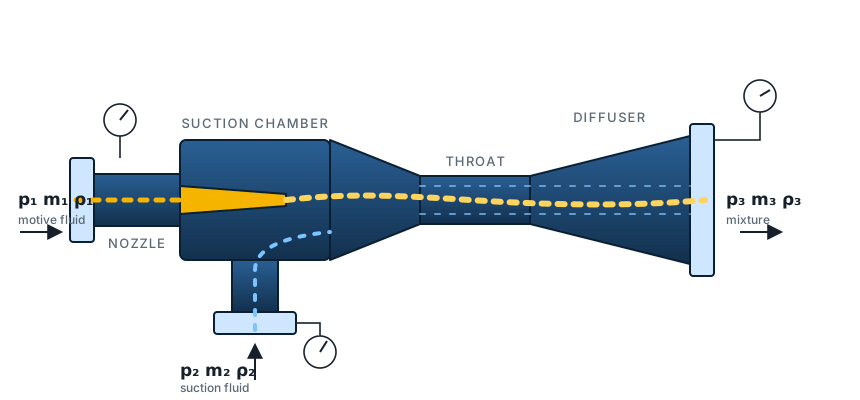
Ejectors (injectors) are jet machines without moving parts: they are driven by the energy of the inlet fluids and operate at efficiencies of η = 0.25–0.75. We have designed and manufactured ejectors for every purpose since 1990.
Ejectors made of metal, plastics, PTFE and other materials – for all purposes, flows and pressures.
Installation of the manufactured equipment in plants and on-site commissioning.
Design documentation for process equipment, pressure vessels, tanks and pipelines.
Conceptual and detailed designs of process plants and other industrial systems, turnkey engineering.
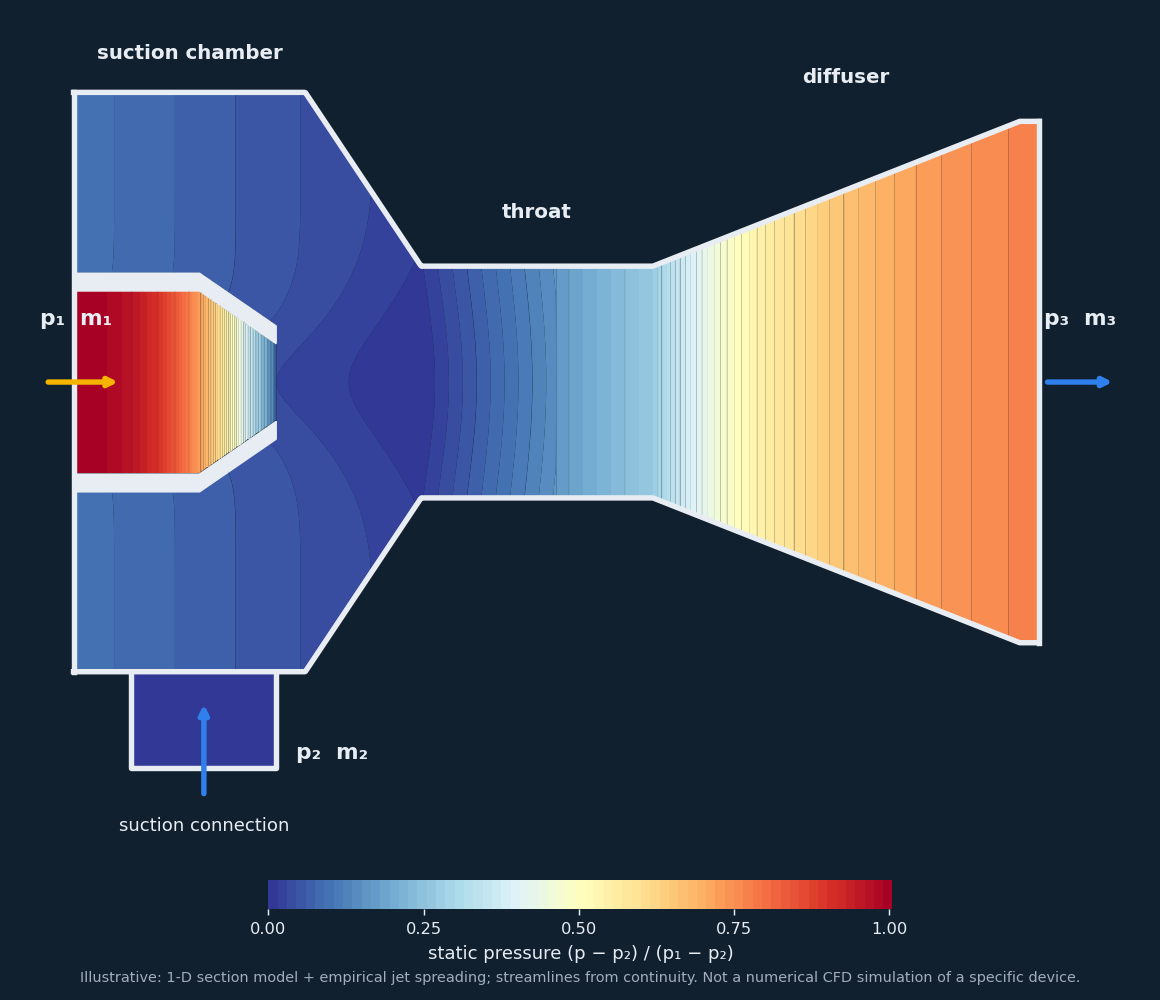
Hover or click on a part of the ejector. The slider changes the motive pressure – the animation shows the jet velocity and entrainment.
The motive fluid – liquid (emulsion, suspension), gas or steam – converts most of its pressure energy into kinetic energy while passing through the nozzle, forming a jet that enters the suction chamber at high (for gases and steam supersonic) velocity.
Read more →Pick a task – we will suggest the suitable ejector types.
All ejector types, regardless of purpose and size, work on the same principle – they are driven by the energy of the inlet fluids. Liquids, gases, vapours and any material that can be fluidised can serve as motive or suction fluid.
Suction, thrusting and transport of all liquids, emulsions and suspensions – even from great depths (H > 500 m).
Read more →Centrifugal pump coupled with an ejector: wider operating range, self-priming, pumping from deep wells.
Read more →Fast and completely homogeneous mixing of liquids, emulsions and suspensions – no moving parts, no agitators.
Read more →Direct heating of liquids with steam or hot water at 100 % heat utilisation.
Read more →Vacuum cooling of liquids, pastes, powders, fruit and vegetables – without refrigerants.
Read more →Safe extraction of polluted, flammable, explosive and aggressive gases and vapours.
Read more →Compression of gases and vapours by liquid, compressed gas or steam – recovery of waste steam into the process.
Read more →Transport of sand, gravel, ash, ore and sludge – pieces up to 25 mm, flows of several hundred m³/h, pressures above 20 bar.
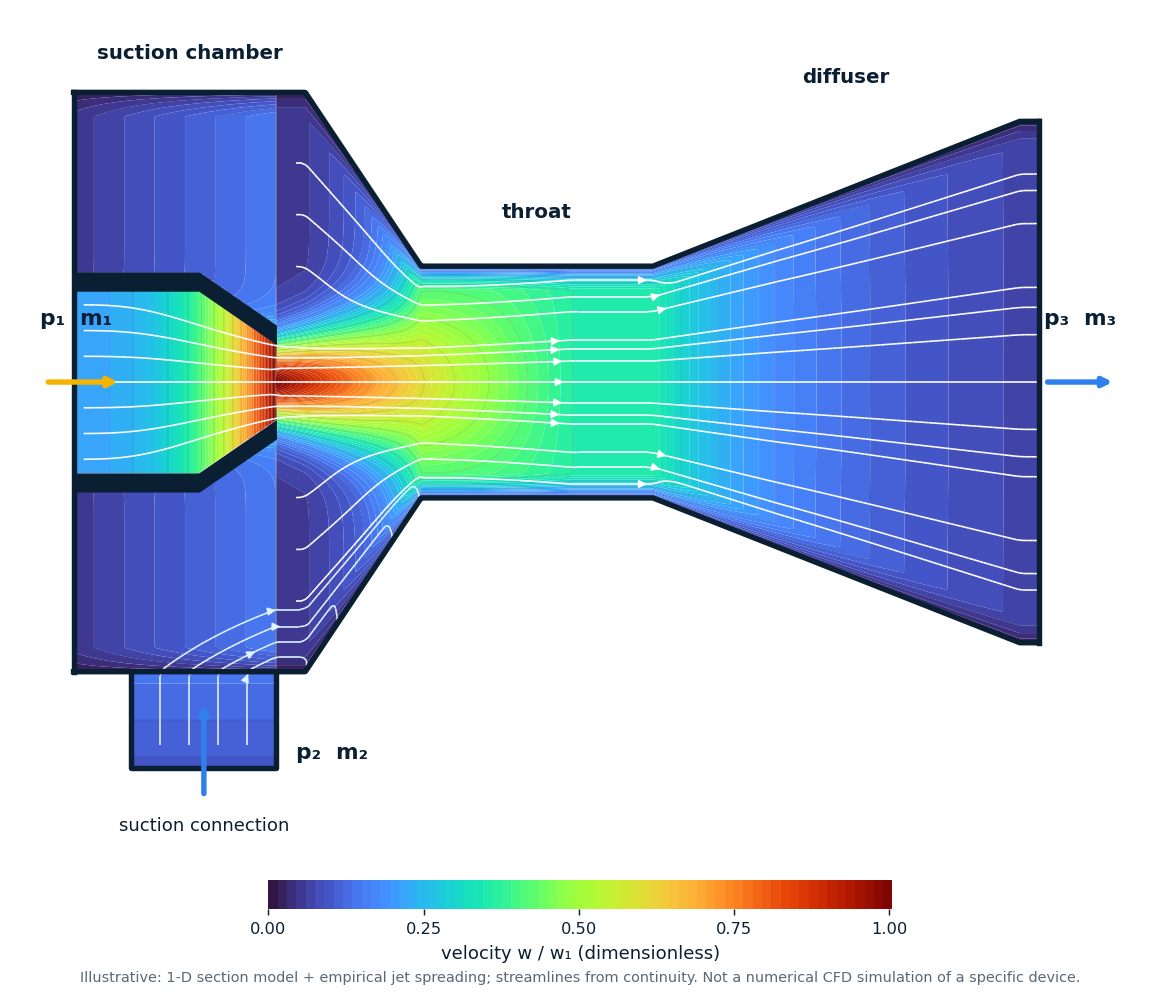
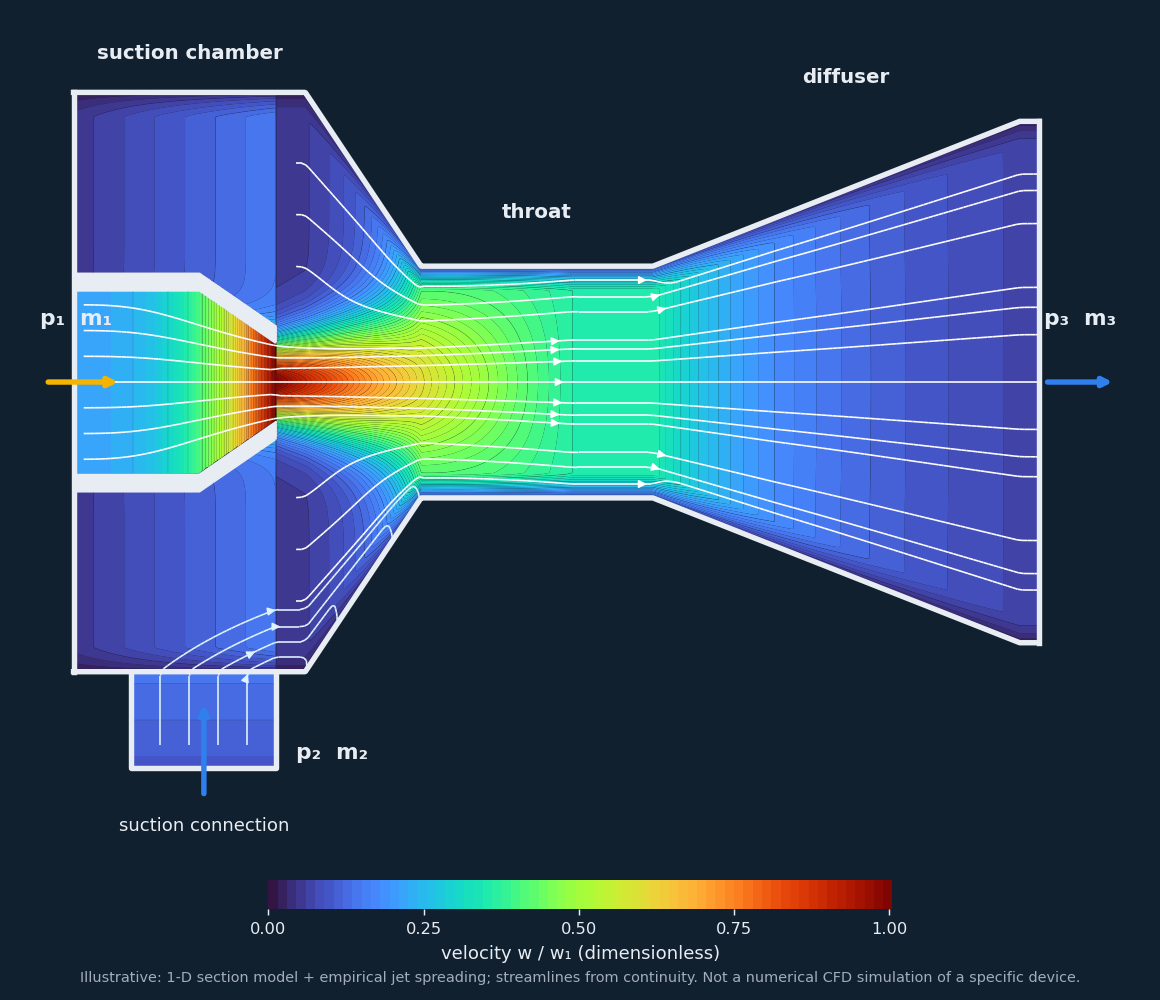
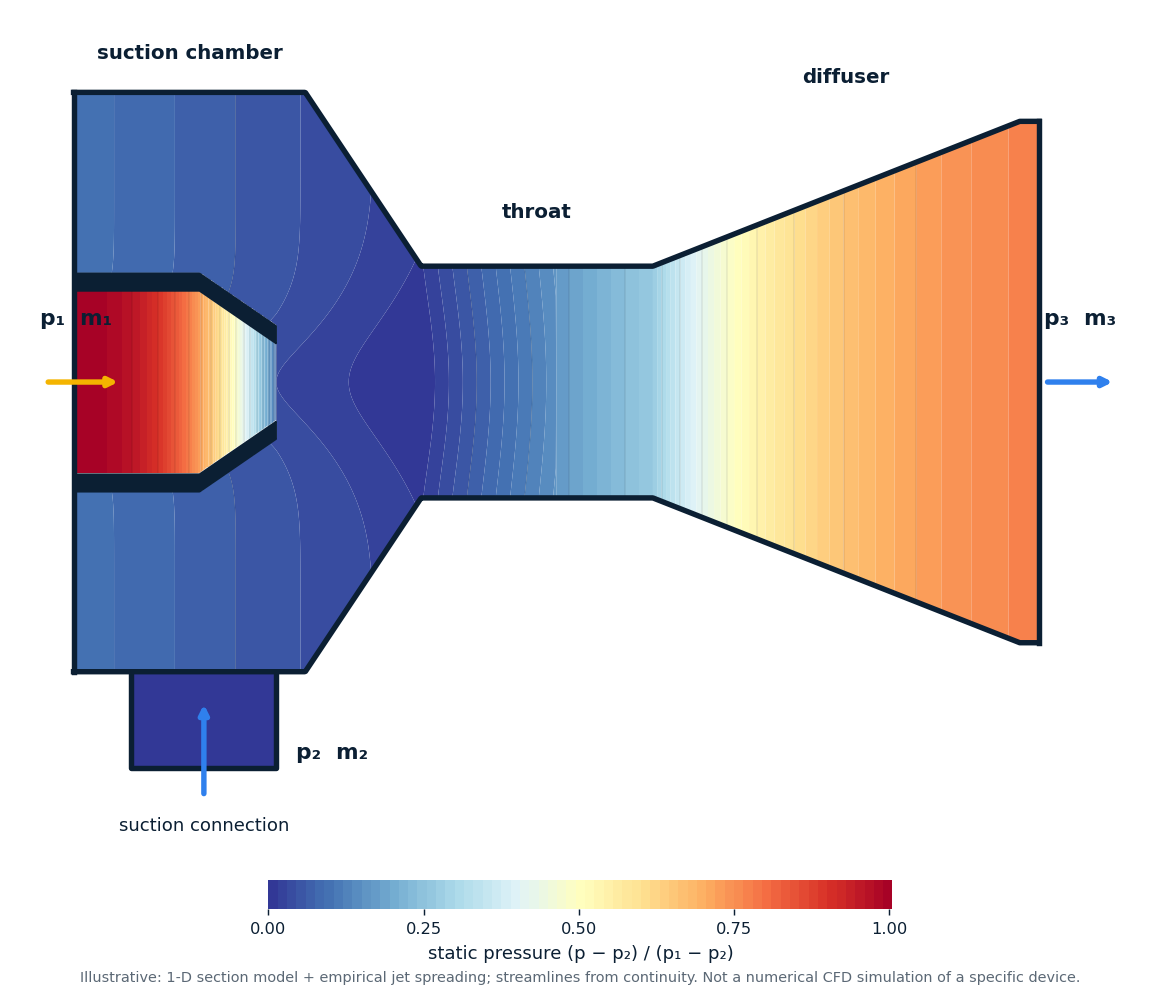
Read more →Illustration of the velocity and static-pressure fields along the ejector: the motive jet accelerates in the nozzle, entrains and mixes the surrounding fluid in the chamber, the velocities equalise in the throat and the kinetic energy is converted into pressure in the diffuser. The picture comes from a 1-D section model and empirical jet spreading and serves for understanding – it is not a CFD simulation of a specific device.


Choose the ejector type, fluids, operating pressures and flows and the connection types – based on the standard 1-D jet-apparatus theory (Sokolov–Zinger) the calculator determines the entrainment ratio and gives the overall dimensions a, b, c, D and the nominal diameters of connections A, B, C with a sketch.